Claude Certified Architect – Professional (CCAR-P) · 공식 시험 가이드 원문과 한글 풀이
이 시험이 원하는 것
Claude 로 production 수준의 AI 시스템을 설계하고, 만들고, 운영까지 맡을 수 있는지 봐요.
쓰임새에 맞는 모델·architecture·API 패턴을 고르고, prompt·context engineering 으로 모델을 이끌어요.
Claude 를 기업 시스템에 integration 하고, 설계에 evaluation·security·compliance·governance 를 넣어요.
stakeholder 와 소통하고, cost·latency·performance·safety·maintainability 사이의 trade-off 를 이해해요.
대상이 아닌 사람 : 입문 개발자, Claude 앱을 가볍게 쓰는 사람, 시스템 설계 책임 없이 프롬프트만 쓰는 사람.
1~4절에서만 끌어낸 요약이에요. 아래 절마다 영어 원문(인용)과 한글 풀이가 있어요.
1. 목적 — 무엇을 검증하나 가이드 2절
The primary purpose of the Claude Certified Architect – Professional certification is to provide an independent assessment of the knowledge, skills, and abilities required to architect Claude-based solutions competently in production environments.
production 환경에서 Claude 기반 해법을 제대로 설계하는 데 필요한 지식·기술·능력을 독립적으로 평가하는 자격이에요.
Earning the credential signals to employers, clients, and teams that the holder can own or significantly contribute to the full lifecycle of a Claude-powered system.
합격하면 고용주·고객·팀에게 "Claude 시스템의 전체 lifecycle 을 맡거나 크게 보탤 수 있다"는 신호가 돼요.
검증하는 능력 7가지
Candidates who earn the credential can demonstrate that they are able to:
합격자가 할 수 있다고 보여 주는 일 7가지예요.
Design and prototype AI-driven solutions that address real business problems
실제 업무 문제를 푸는 AI 해법을 설계하고 prototype 으로 만들어요.
Select appropriate models, architectures, and API patterns for specific use cases
쓰임새에 맞는 모델·architecture·API 패턴을 골라요.
Implement prompt engineering and context strategies to guide model behavior
prompt engineering 과 context 전략으로 모델 동작을 이끌어요.
Integrate Claude into production systems using APIs, orchestration tools, and data pipelines
API·orchestration 도구·data pipeline 으로 Claude 를 production 시스템에 붙여요.
Apply evaluation, monitoring, and observability practices to ensure solution quality
evaluation·monitoring·observability 로 해법 품질을 지켜요.
Incorporate security, compliance, and governance considerations into system design
security·compliance·governance 를 시스템 설계에 넣어요.
Collaborate with cross-functional stakeholders and communicate architectural decisions effectively
여러 부서의 stakeholder 와 함께 일하고 architecture 결정을 잘 전해요.
2. 대상과 대상 아님 가이드 3절
대상
The certification is intended for mid- to senior-level technical professionals who design, build, and deliver production-grade AI solutions using large language models, particularly Claude.
LLM(특히 Claude)으로 production 수준 AI 해법을 설계·구현·납품하는 중급~시니어 기술자가 대상이에요.
This audience primarily includes solution architects, AI/ML engineers, technical leads, and senior software engineers who operate at the intersection of business requirements and technical implementation.
주로 solution architect, AI/ML engineer, technical lead, senior software engineer 예요. 업무 요구와 기술 구현이 만나는 자리에서 일하는 사람이에요.
These professionals translate business problems into scalable AI-driven solutions, including model selection, prompt engineering, orchestration of tools and agents, context management, and ensuring system safety, compliance, and governance.
업무 문제를 확장 가능한 AI 해법으로 옮겨요. 모델 고르기, prompt engineering, 도구·에이전트 orchestration, context 관리, 시스템 safety·compliance·governance 까지요.
They are often involved in stakeholder engagement, advising clients or internal teams, and leading architectural decisions, including discussions of security, legal, and executive considerations.
stakeholder 를 만나고, 고객·내부 팀에 조언하고, security·법무·경영진 쪽 논의까지 포함해 architecture 결정을 이끌어요.
Candidates typically work across industries such as financial services, healthcare, retail, technology, education, and government.
금융·의료·유통·기술·교육·공공 같은 여러 업종에서 일해요.
대상 아님
This certification is not intended for entry-level developers, casual users of Claude-based applications, or individuals without experience designing end-to-end AI systems.
입문 개발자, Claude 앱을 가볍게 쓰는 사람, end-to-end AI 시스템을 설계해 본 적 없는 사람은 대상이 아니에요.
It also excludes roles that are purely non-technical or limited to isolated tasks such as prompt writing without broader system design responsibility.
기술과 무관한 역할, 시스템 설계 책임 없이 프롬프트 쓰기 같은 따로 떨어진 일만 하는 역할도 빠져요.
3. 합격 기준 수험자(MQC)와 권장 경력 가이드 4절
The exam is targeted at the minimally qualified candidate (MQC): an experienced practitioner who combines an engineering mindset with practical, real-world experience deploying AI solutions.
시험은 최소 자격을 갖춘 수험자(MQC)에 맞춰져 있어요. engineering 사고방식에 AI 해법을 실제로 배포해 본 경험을 더한 실무자예요.
The MQC designs, implements, and governs Claude-powered AI solutions within production environments, translating business requirements into scalable, secure, and reliable architectures.
MQC 는 production 환경에서 Claude AI 해법을 설계·구현하고 governance 까지 맡아요. 업무 요구를 확장 가능하고 안전하고 믿을 만한 architecture 로 옮겨요.
The MQC demonstrates the ability to design end-to-end AI systems, including prompt and context engineering, retrieval-augmented generation (RAG), API integration, orchestration, and evaluation frameworks, and understand trade-offs related to cost, latency, performance, safety, and maintainability.
prompt·context engineering, RAG, API integration, orchestration, evaluation framework 를 갖춘 end-to-end AI 시스템을 설계하고, cost·latency·performance·safety·maintainability 사이의 trade-off 를 이해해요.
Recommended experience — 권장 경력
A foundation in software engineering best practices (modular design, separation of concerns, scalability)
3+ years of experience in systems architecture or platform engineering
systems architecture 또는 platform engineering 경력 3년 이상
6+ months of hands-on experience with Claude or comparable LLM-based systems in production
production 에서 Claude 나 비슷한 LLM 시스템을 직접 다뤄 본 경험 6개월 이상
Experience delivering end-to-end systems from discovery through deployment and operationalization
discovery 부터 배포·운영까지 end-to-end 시스템을 납품해 본 경험
필수 조건
Prerequisites: There are no mandatory prerequisites or courses required to sit this exam.
필수 조건도, 꼭 들어야 하는 과정도 없어요.
The experience above is recommended, not required.
위 경력은 권장일 뿐 필수가 아니에요.
The credential is awarded based on exam performance alone.
자격은 시험 성적 하나로만 줘요.
4. 형식과 채점 가이드 5 · 6 · 9절
그림으로 보기 (AI 생성 · Codex · 누르면 크게)
항목
원문
풀이
Credential
Claude Certified Architect – Professional
자격 이름
Exam code
CCAR-P
시험 코드
Number of items
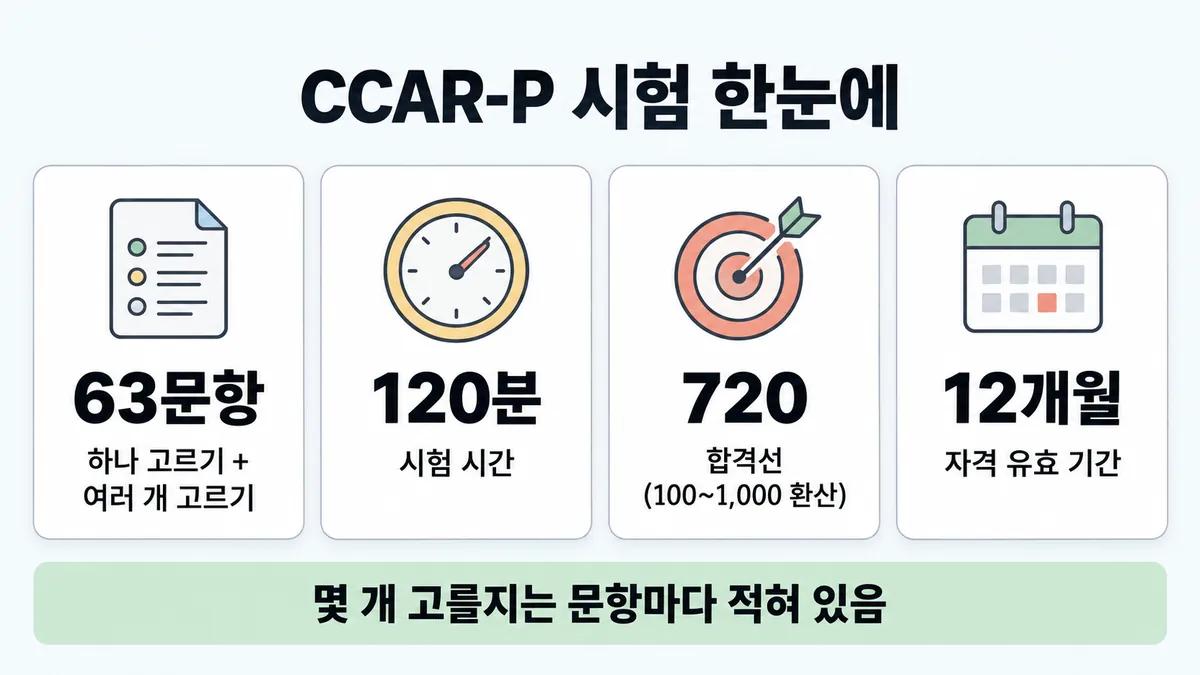
63
63문항
Item format
Multiple-choice and multiple-response items; each item states how many responses to select
하나 고르기(multiple-choice)와 여러 개 고르기(multiple-response)가 섞여요. 몇 개 고를지는 문항마다 적혀 있어요.
Time limit
120 minutes
120분
Delivery
Proctored: online proctored and/or test center, per program policy
감독관이 있는 시험이에요. 온라인 감독 또는 시험장 (프로그램 정책에 따라)
Passing score
Scaled score of 720 on a scale of 100–1,000
환산 점수 100~1,000 중 720 이면 합격
Exam fee
$175 USD
응시료 175달러
Validity period
12 months from the date the credential is awarded
자격을 받은 날부터 12개월
Result reporting
Pass/fail with scaled score (100–1,000), plus percent-correct by domain on the score report
합격·불합격과 환산 점수. 성적표에 도메인별 정답률도 나와요.
계산 문항당 약 1.9분 (120분 ÷ 63문항 = 1.90분)
도메인별 대략 문항 수
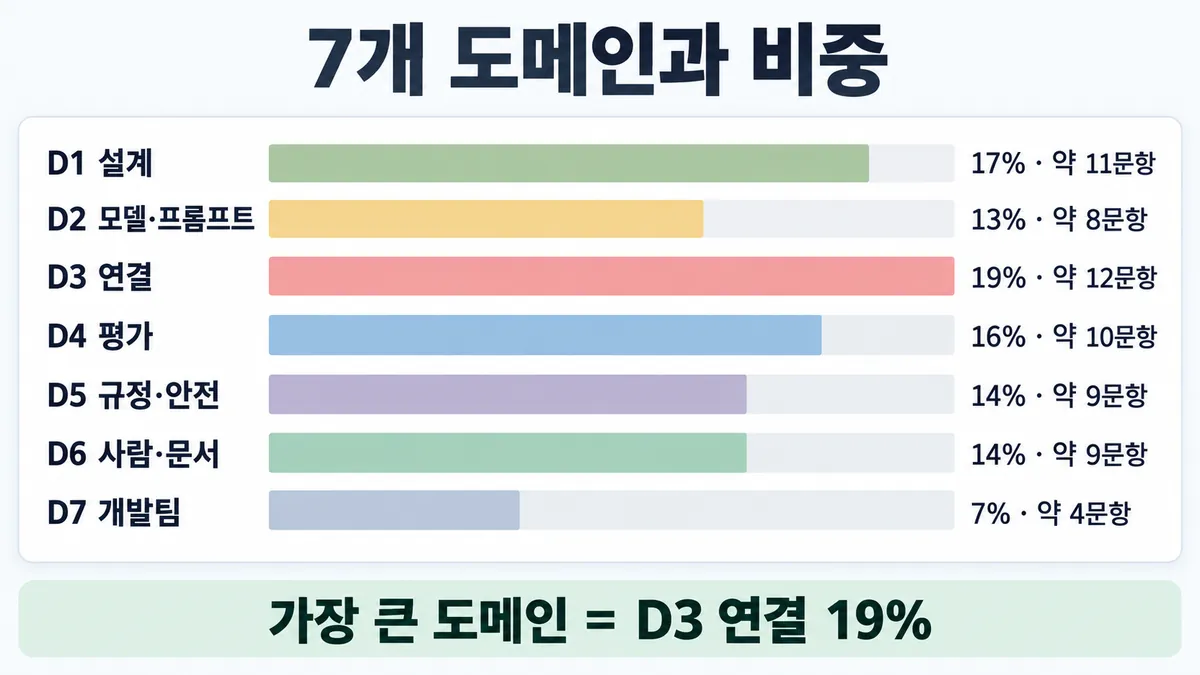
The percentages indicate the approximate proportion of scored items drawn from each domain.
비중은 채점 문항 가운데 그 도메인에서 나오는 대략의 몫이에요. 아래 문항 수는 이 비중으로 셈한 값이에요.
도메인
공식 이름
비중
대략 문항 수 계산
D1
Solution Design & Architecture
17%
약 11 (63 × 17% = 10.71)
D2
Claude Models, Prompting & Context Engineering
13%
약 8 (63 × 13% = 8.19)
D3
Integration
19%
약 12 (63 × 19% = 11.97)
D4
Evaluation, Testing & Optimization
16%
약 10 (63 × 16% = 10.08)
D5
Governance, Safety & Risk Management
14%
약 9 (63 × 14% = 8.82)
D6
Stakeholder Communication & Lifecycle Management
14%
약 9 (63 × 14% = 8.82)
D7
Developer Productivity & Operational Enablement
7%
약 4 (63 × 7% = 4.41)
채점 방식 가이드 9절
The Claude Certified Architect – Professional exam is a criterion-referenced assessment: each candidate is measured against a fixed performance standard, not against other candidates.
criterion-referenced 시험이에요. 정해진 기준에 대 보는 것이지, 다른 수험자와 겨루는 게 아니에요.
You pass by demonstrating the knowledge and skills defined in the blueprint, not by outperforming a percentage of peers.
상위 몇 % 에 들어야 붙는 게 아니라, blueprint 에 적힌 지식·기술을 보여 주면 붙어요.
Passing standard. The passing score was established through a formal standard-setting study in which trained subject matter experts judged the level of performance expected of a minimally qualified candidate.
합격선은 훈련받은 전문가들이 MQC 에게 기대할 수준을 판단한 standard-setting 연구로 정했어요.
The score is reported on a scaled range of 100–1,000, and the cut score is 720.
점수는 100~1,000 환산 점수로 나오고, 합격선은 720 이에요.
Your score report also shows the percentage of items you answered correctly within each content domain.
성적표에는 도메인마다 맞힌 비율도 나와요.
Section-level percentages are provided to help you understand your performance and are not used to determine your pass or fail result, which is based on your total scaled score.
도메인별 비율은 참고용이고 합격 판정엔 안 써요. 합격은 전체 환산 점수로만 정해요.
5. 도메인과 목표 38개 가이드 6절
그림으로 보기 (AI 생성 · Codex · 누르면 크게)
Each domain below lists the tasks a candidate is expected to perform. Exam items are written against these objectives.
도메인마다 수험자가 해낼 일을 적었어요. 문항은 이 목표를 기준으로 써요.
Domain 1: Solution Design & Architecture (17%)
D1 설계 · 약 11문항 (계산)
1.1Translate business problems into Claude-based AI solutions
These illustrative items show the style and cognitive level of the exam. They are not drawn from the live item bank.
시험 문항의 모양과 수준을 보여 주는 예제예요. 실제 문항 은행에서 뽑은 건 아니에요.
Sample 1 · Domain 3 — Integration
A team exposes a customer-support agent that can read tickets, draft replies, issue refunds, and delete user accounts. Support staff only ever need to read tickets and draft replies. Applying least-privilege principles, which change best reduces risk?
A.Add logging to the refund and delete tools so misuse can be audited later.
B.Remove the refund and delete tools from the agent's configuration entirely.
C.Keep all tools but add a confirmation prompt before refunds and deletions.
D.Replace the agent with a larger model that follows instructions more reliably.
정답·해설 보기 (Answer key and rationale)
Sample 1: B. Least privilege means removing capabilities the role does not require, eliminating the attack surface rather than monitoring or guarding it. Logging (A) and confirmations (C) are detective/compensating controls, not removal of unnecessary privilege; model size (D) is unrelated to authorization scope.
정답 B. least privilege 는 그 역할에 필요 없는 능력을 아예 빼는 것이에요. 공격면(attack surface)을 지켜보거나 막는 게 아니라 없애요. 로그(A)와 확인 창(C)은 나중에 잡아내거나 메워 주는 통제일 뿐 불필요한 권한을 없애지 않고, 모델 크기(D)는 권한 범위와 상관없어요.
An application sends the same 8,000-token system prompt and policy document on every request, followed by a short, varying user message. Latency and cost are both concerns. Which optimization most directly addresses both?
A.Truncate the policy document to the first 1,000 tokens.
B.Switch to the smallest available model regardless of task fit.
C.Place the static system prompt and policy before the dynamic content and enable prompt caching.
D.Move the policy document into a few-shot example block.
정답·해설 보기 (Answer key and rationale)
Sample 2: C. Ordering stable content first and enabling prompt caching lets repeated prefixes be reused, reducing both time-to-first-token and per-request cost without discarding required context. Truncation (A) loses needed policy; downsizing blindly (B) risks quality; relocating to few-shot (D) does not create a cacheable, reusable prefix.
정답 C. 안 바뀌는 내용을 앞에 두고 prompt caching 을 켜면 되풀이되는 앞부분(prefix)을 다시 써요. 필요한 context 를 버리지 않고 time-to-first-token 과 per-request cost 를 함께 줄여요. 자르기(A)는 필요한 정책을 잃고, 무작정 작은 모델(B)은 품질이 위험하고, few-shot 으로 옮기기(D)는 캐시해 다시 쓸 prefix 를 만들지 못해요.
A RAG system suddenly returns confident but incorrect answers after a document refresh, while latency and model version are unchanged. What is the most likely first place to investigate?
A.The model weights have silently changed.
B.The retrieval/indexing step is returning irrelevant or stale chunks.
C.The temperature setting is too low.
D.The context window has shrunk.
정답·해설 보기 (Answer key and rationale)
Sample 3: B. Confident-but-wrong answers following a document refresh, with model and latency unchanged, point to retrieval feeding the model poor context, for example a broken re-index or mismatched embeddings. The other options would not be triggered specifically by a document refresh.
정답 B. 문서를 새로 고친 뒤 자신 있게 틀리는데 모델·latency 는 그대로라면, retrieval 이 모델에 나쁜 context 를 넣고 있다는 뜻이에요. 예를 들어 re-index 가 깨졌거나 embedding 이 안 맞는 경우예요. 나머지 보기는 문서 새로 고침 때문에 생기는 일이 아니에요.
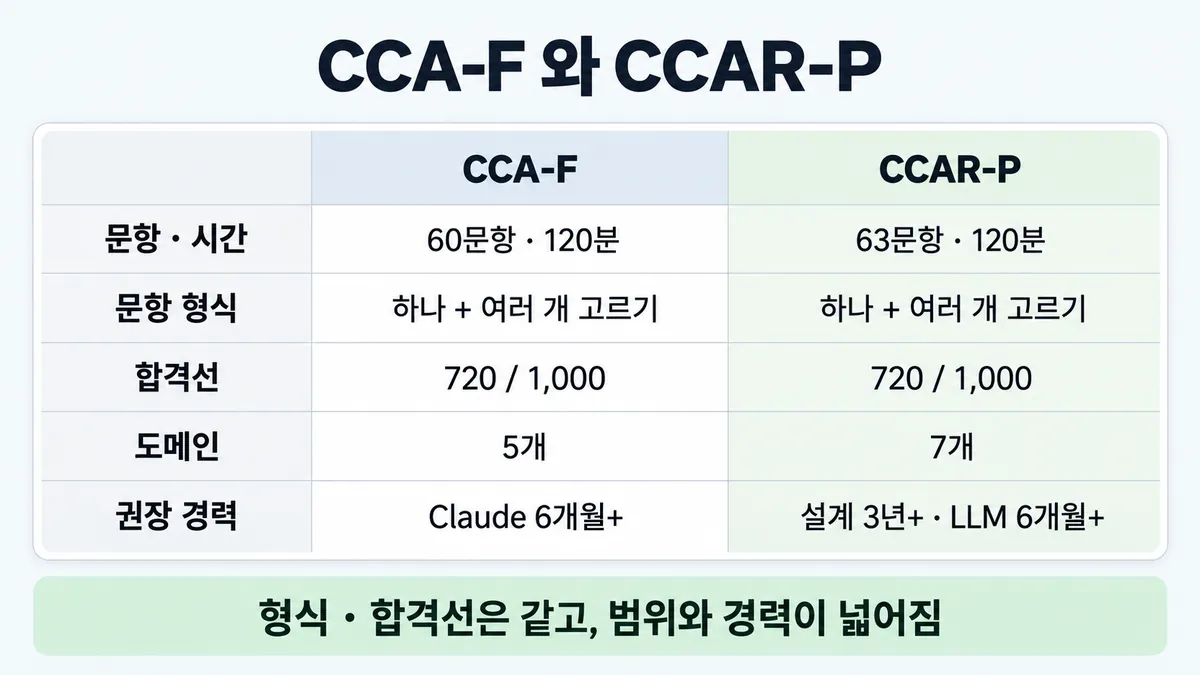
두 칸 모두 Anthropic 공식 시험 가이드에서 옮겼어요 — CCA-F 칸은 CCA-F 공식 시험 가이드 v1.0 (Claude Certified Architect – Foundations, 공식 시험 코드 CCAR-F), CCAR-P 칸은 공식 시험 가이드 v1.0. 절 번호는 각 가이드의 번호예요.
항목
CCA-F — CCA-F 공식 시험 가이드 v1.0
CCAR-P — 공식 시험 가이드 v1.0
문항 수·시간
60
120 minutes
60문항 · 120분
출처 : CCA-F 가이드 · 3절 Number of items · Time limit
63문항 · 120분
출처 : CCAR-P 가이드 · 5절 Number of items · Time limit
문항 형식
Multiple-choice and multiple-response items; each item states how many responses to select
CCAR-P 와 같아요. 하나 고르기와 여러 개 고르기가 섞이고, 몇 개 고를지는 문항에 적혀 있어요.
출처 : CCA-F 가이드 · 3절 Item format
Multiple-choice and multiple-response items; each item states how many responses to select
하나 고르기와 여러 개 고르기가 섞여요. 몇 개 고를지는 문항에 적혀 있어요.
출처 : CCAR-P 가이드 · 5절
시나리오
4 scenarios drawn from a bank of 6
6개 가운데 4개가 나와요. 가이드 5절에 시나리오 6개가 적혀 있어요.
출처 : CCA-F 가이드 · 3절 Exam structure · 5절
including questions, answer options, and scenarios
가이드에 시나리오 목록은 없어요. 13절 비밀유지 문구에 scenarios 라는 말만 나와요.
출처 : CCAR-P 가이드 · 13절
도메인 수
5개
출처 : CCA-F 가이드 · 4절
7개
출처 : CCAR-P 가이드 · 6절
도메인 이름·비중
Agentic Architecture & Orchestration 27%
Tool Design & MCP Integration 18%
Claude Code Configuration & Workflows 20%
Prompt Engineering & Structured Output 20%
Context Management & Reliability 15%
출처 : CCA-F 가이드 · 4절
Solution Design & Architecture 17%
Claude Models, Prompting & Context Engineering 13%
Integration 19%
Evaluation, Testing & Optimization 16%
Governance, Safety & Risk Management 14%
Stakeholder Communication & Lifecycle Management 14%